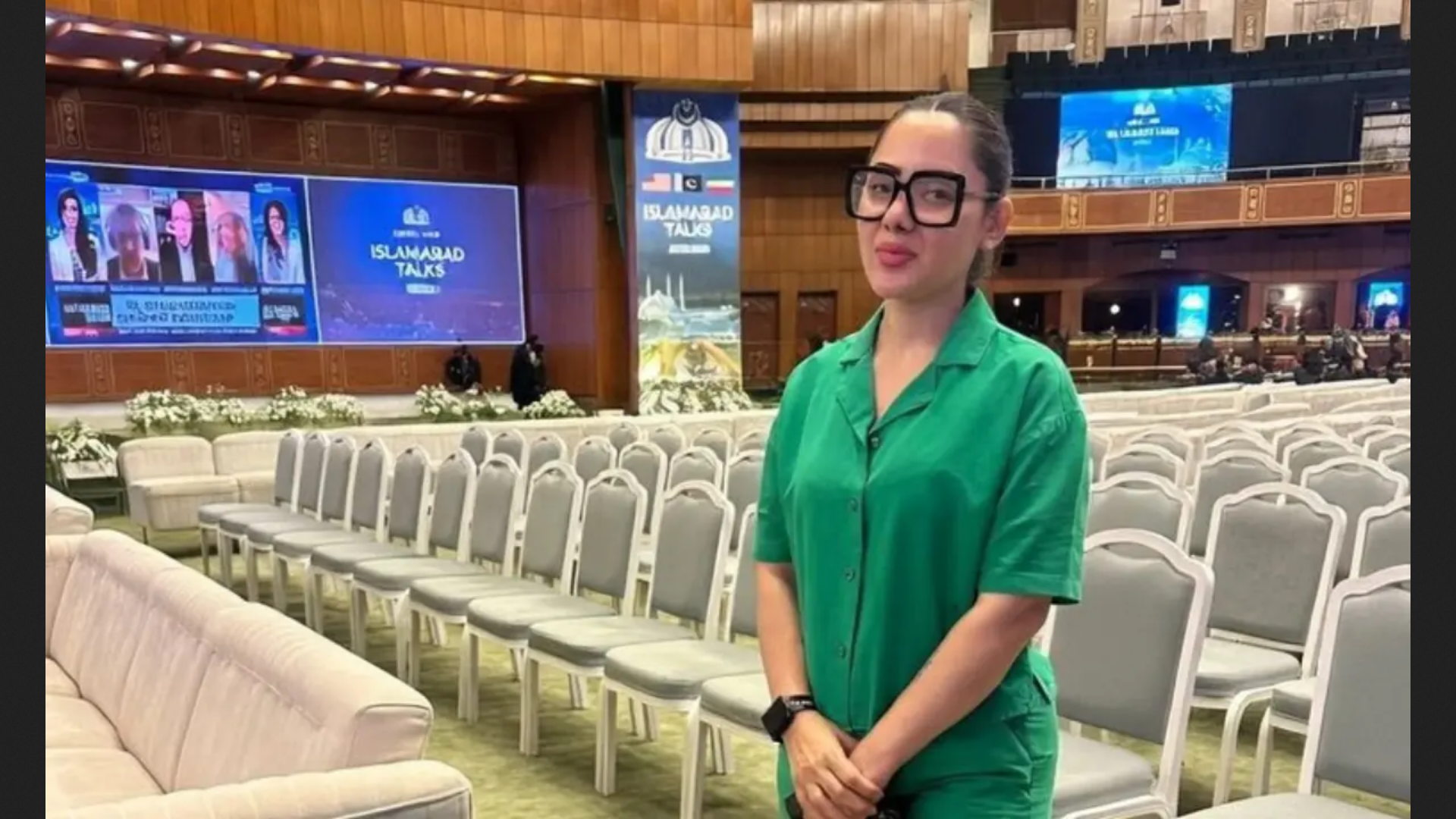
Pakistan journalist Gharidah Farooqi has been targeted in yet another online attack after morphed pictures of her from the Islamabad Peace Talks 2026, held from 11th to 12 April, 2026, started circulating on social media.
Farooqi, who attended the historic event in green pants and shirt, was targeted by men and some women, on social media, for her choice of clothes. In another instance, she was compared to a journalist from Iran, clad in a burqa.
“This is NOT criticism neither on attire. A picture taken without my consent from a private angle, then MORPHED, and turned into a planned smear vile campaign of harassment. Not the first time against me, been facing and fighting this all since 2011, but it terrorises the women of a society as a whole,” she wrote on X while responding to the morphed pictures.
This is not the first time a woman journalist has been online harassed while working. In 2020, more than two dozen women journalists shared and opened up on their stories of grotesque online harassment, unedited and mostly uninterrupted, for four hours to the Human Rights Committee of Pakistan’s National Assembly. The hearing was the first result of a rare and public show of solidarity of women journalists, who issued a joint letter on August 12 asking for government action to stop the harassment.
In 20219, a report launched by Media Matters for Democracy (MMfD) shows that all female journalists within the country face some type of online violence . The report shows that 95 percent of women journalists feel online violence has an impact on their professional choices, while 77 percent self-censor as a way to counter online violence. The abuse female journalists face in online spaces is often not taken seriously, but has real repercussions for them. The results showed that 105 out of 110 women believe online violence impacts the mental health of female journalists.
A 2026 research found that online harassment of women journalists is not “incidental but is deeply structural and is shaped by the gender norms, the political polarisation, and overall weak institutional protections.” The study also found that women who faced online harassment suffer from insomnia, self-doubt, isolation, emotional exhaustion.