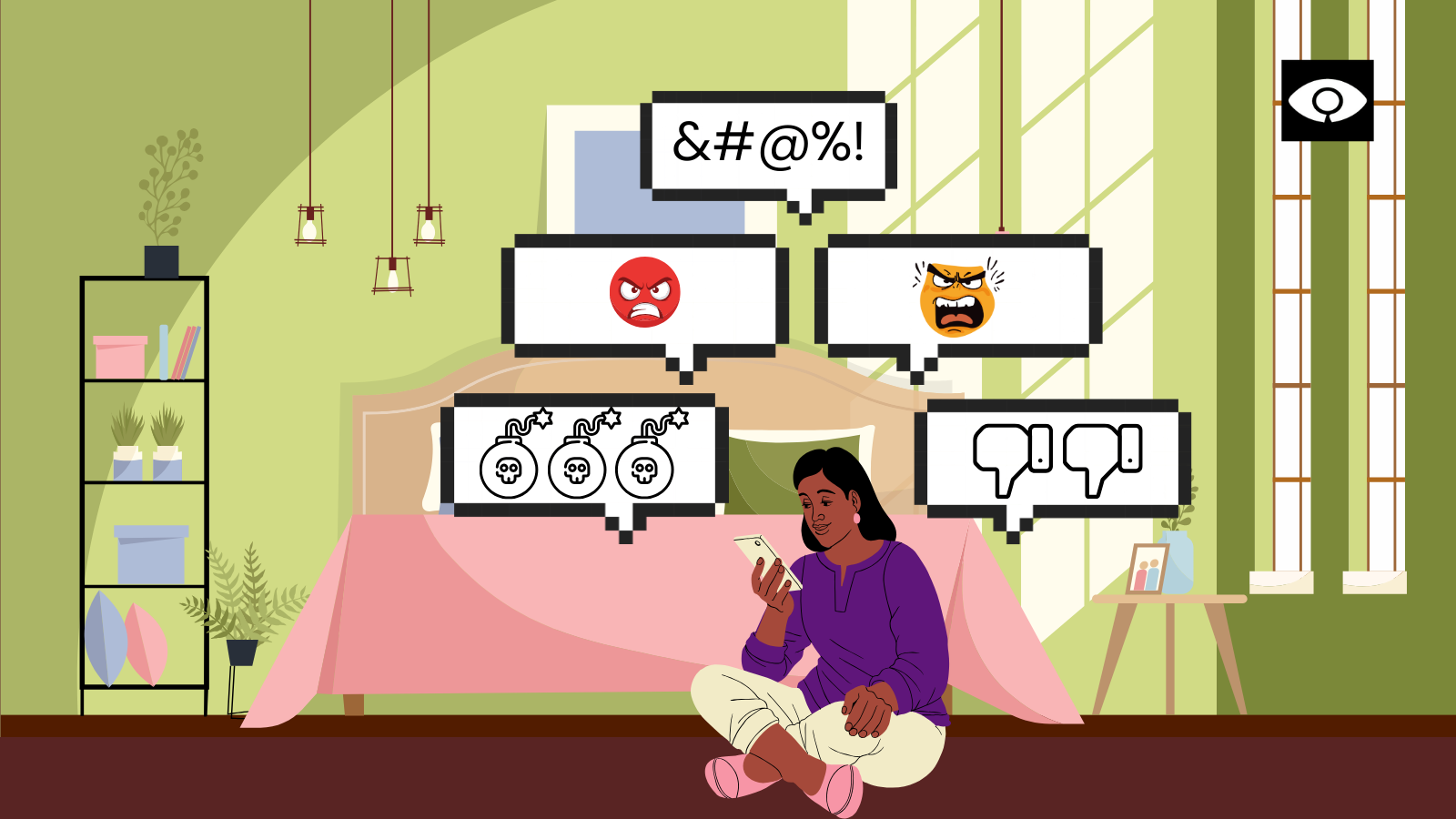
Anita Jalil Baloch, who identifies as the first woman vlogger from Gwadar in Balochistan, has repeatedly endured online harassment, hate speech, defamation, and even physical threats targeting her appearance and outspoken presence on social media. Yet these attacks have rarely deterred her from continuing to create public interest content.
Baloch moved in with her father living in Gwadar from Dubai after her mother’s death. She went ahead to complete her Bachelors in Arts, and even worked at different places including the Gwadar Port, the passport office, a life insurance company and even as a receptionist at GDA Hospital.
In 2018, Gwadar was frequently in the news, often framed as an emerging hub for trade, e-commerce, and economic opportunity. People from across the globe would visit Gwadar to make travel vlogs, which Baloch used to watch with interest until she decided to showcase her city from her lens to the broader audience.
“I had the idea but having an intention alone is never enough. I didn’t know how to make vlogs, camera handling and editing,” she shared with DRM. “The biggest challenge, however, was family acceptance because since childhood, this belief had been deeply planted in my mind that, Baloch women do not appear on screen. They don’t upload pictures; they don’t come on social media. I used to hear, if a decent family’s girl’s photo went viral, she would end up dying by suicide. All of these fears lived in my mind. Like others typical Baloch parents my father was also not happy but I got a permission,” she added.
She received a mixed reaction when she started vlogging earlier: her followers and subscribers on Facebook and Instagram stood by her, while there were others who believed she had ‘ruined’ the name of Baloch people. “So coming from a conservative society, I was already aware of how harsh reactions can be, especially toward women who appear on screen. Even before starting vlogging, I had witnessed how women are judged, monitored and attacked online and offline. So I knew this space would not be easy,” Baloch said.
The digital violence didn’t stop only at her identity as a Baloch women, she even received religious backlash because of her efforts to promote religious harmony. She had visited churches, temples, jamaatkhanas, and Zikri places of worship in Gwadar.
A propaganda campaign was launched against her after she posted a picture of herself visiting a zikr khana with the caption: “Peace”. Rumours started circulating on WhatsApp that she had changed her religion and this quickly escalated into her receiving death threats.She added that she had been publicly targeted, and one evening, an empty wine bottle was flung at her while she was walking on Marine Drive. The incident terrified her and she realised that even police protection might not keep her safe. As a result, she had to go into hiding for three months, moving between Quetta and Karachi. She had not returned home and had suffered severe anxiety, living in constant fear that someone might harm her.
Baloch even mentioned a case that she filed with the FIA against a male politician, who made vulgar comments about her body. “It was on a picture where I was fully covered, with proper clothing and my head covered with a dupatta, yet he shamelessly discussed my body parts on social media post.” She added, “At first I thought to ignore. But then I realised, this is a well-known person. If he has the guts to behave like this, imagine how much audacity an ordinary person might have.”
So, she decided to file a case. However, through this experience, she realised that while laws exist, they are weak and slow. Eventually, out of frustration, she withdrew the case and decided to handle the situation on her own. She posted screenshots of his messages along with his picture, to shame his thinking publicly.
A vlogger and journalist from Lahore Laiba Zainab shared similar experiences of facing technology-facilitated gender-based violence. In 2018, when she was completing her Master’s in Karachi, she attended Aurat March and there was a widespread discussion about it. She mentioned that one particular post card, which read “apna khana khud garam karo (heat your own food)” had gone viral on social media, sparking intense debates. She decided to make a short video on the topic and posted it on her Facebook page, which didn’t have many followers at the time.
Following this, she had to brave online abuse, including rape threats, severe harassment, morphed images of her, edited pictures of her family, death threats, and even blasphemy allegations. The situation had become so unbearable that she had turned off notifications on her Facebook page and had never turned them back on.
She added that she occasionally checked the notifications but had not read the messages for years, as they mostly contained abusive and meaningless content. She said that now her Facebook profile was largely public, as were her Instagram, TikTok, and Twitter accounts, and because of this, she still had to face a great level of online harassment across platforms.
“There was also a constant fear that online threats could turn into offline harm. However, since I’ve been active on social media for many years, it became very clear to me that a large portion of the abuse was directed at me simply because of my gender. Many people speak on political and social issues, but they don’t receive the same level of abuse that I did or that I saw other women receive whom I followed online,” she remarked.
She recalled another incident when she had posted a photo on Twitter after her toenail was broken, and she hadn’t thought much of it. Finding the image visually interesting in terms of lighting and composition, she posted it with a lighthearted caption: sometimes a broken toenail hurts more than a broken heart. She explained that the reaction that followed had been unbelievable. People commented that they were “male feet,” called her disgusting, and hurled all kinds of abuse. She said she couldn’t understand the purpose of all that hatred or why it had even happened.
Talking about the reporting the post on social media she said she believed social media platforms are not very effective in this matter. She had reported many posts and accounts, but very rarely had any real action been taken against them. She added that maybe it had happened once or twice in all those years. Otherwise, she felt the biggest problem was context, as they often didn’t understand the context of a statement, she explained.
She gave an example, saying that if someone said, “you should face what happened to the woman on the motorway”(a rape threat in Pakistan referring to the motorway rape case in Lahore), they didn’t grasp the meaning behind it. In their view, this wasn’t abuse, but from her perspective, it wa a rape threat.
“I’m not an expert myself, but I have studied cyber laws quite extensively and keep reading and staying updated about them. I observe what changes are happening in policies and laws, and also what new schemes or initiatives are being introduced. But I don’t think the victims have access to proper legal or psychological support,” Zainab added.
Setting boundaries and taking a break
Baloch said that she wanted to tell content creators/vloggers that their fear is real and valid, and that trolls can be cruel, but as women their voices matter. One should not wait to become fearless, but start speaking out even if they are scared, she advised.
She recommended that women vloggers should take all necessary precautions to protect themselves, set boundaries and taking a break when needed. Baloch emphasised that one does not have to explain themselves to everyone, and most importantly, should not let strangers decide the limits of their life.
She said that she celebrated her community by engaging respectfully, highlighting positive stories, sharing meaningful feedback, and creating content that reflects honesty and respect. She added that this positive audience was her strength.
Zainab, on the other hand, said the most important change she wants people to accept that women as humans too. Once that happens, people would see a journalist speaking, not just a woman journalist. She added that women should be free to share their opinions, pursue journalism, and work on any topic they choose.
She noted that despite challenges, her passion for journalism kept her going. She highlighted that abuse and criticism would not silence her, as she had worked hard to build her career and her voice. She acknowledged that though it was difficult and sometimes discouraging, she would never give up her online space to keyboard warriors.
Rights activist and journalist Ayesha Khalid notes that it is crucial for women to have digital literacy understanding how to protect their online identities, remove data from photos, turn off location settings, and avoid revealing personal information like home addresses. Digital literacy empowers women to safeguard their privacy and navigate online spaces safely, she said.
She mentioned culturally and socially, women have long faced pressure to follow strict norms, while men are largely free from such expectations. Women are expected to behave, look, and present themselves in ways deemed “acceptable,” or they risk judgment and disrespect. However no culture or religion dictates how women should govern themselves; it is up to each woman to set boundaries and present herself as she chooses. Unfortunately, this kind of harassment is not limited to Pakistan it happens globally. She concluded that such behavior is wrong and needs to change.
She added ethics committees at workplaces are essential to protect women journalists from harassment, but they must be independent and effective. These committees should include neutral external members who are not influenced by organisational hierarchies, as internal-only committees often fail victims.
To be effective, ethics committees must be properly trained, well-equipped, and capable of conducting thorough investigations. A balanced structure such as equal representation from within and outside the organization, including digital rights experts can ensure fairness, accountability, and genuine support for victims, she highlighted.
A pattern
Women in Pakistan who are vocal in digital spaces, whether they are journalists, human rights defenders (HRDs), activists, or content creators, are often met with the online harassment and abuse intended to silence them. This includes hate speech, physical threats, stalking, bullying, character attacks and defamation campaigns. For most women, the harm does not stay in digital spaces and also affects their psychosocial well-being, work, and physical safety.
Even deep fake abuse, where images or videos of someone posted online can result offline reputational damage with lasting and devastating effects on a person’s life. This defines the complexities of technology-facilitated violence against women and girls and how its scope can be harder to define, as harm often permeates both online and offline spaces.
In past we have seen many examples how digital technology used against women, including Balochistan MPA Meena Majeed, senior journalist Garidah Farooqui, Aurat March activists and many female Tiktokers. It would not be wrong to say that digital harassment is a poison or silent epidemic and often ‘awful but lawful’.
Globally, about 38% of women report experiencing some form of online violence, while 85% said they have witnessed it happening to other women, according to The Economist Intelligence Unit.
A 2025 Bytes for All (B4A) research, titled ‘Exploring the Grounds of Digital Violence Against Women in Pakistan’, reported as many as 50 cases of women being targeted in online spaces for their profession. Forty-five cases of strategically planned smear campaigns were reported which aimed to tarnish a woman’s ‘image’, particularly of content creators. Over 35 cases of leaked videos or non-consensual sharing of sexual images were reported.
The Digital Rights Foundation (DRF) recorded 3,171 complaints of technology-facilitated gender-based violence, including 2,741 cases of cyber harassment in 2024. Approximately 56% of the cases received by their Cyber Harassment Helpline were reported by women. These numbers show how dangerous digital platforms have become, particularly for women who choose to be vocal and visible.
The threat of online harassment, image-based abuse, deep fakes, and AI-generated content is extremely serious for women in today’s technology-driven world. The widespread use of the internet and AI tools has made it easier to create and circulate non-consensual images and manipulated content. As deepfake technology becomes more sophisticated and accessible, the scale and impact of such abuse continue to grow, making women disproportionately vulnerable, Hyra Basit said, Senior Project Manager at DRF, shared.
Adding to this, she said that despite the seriousness of this threat, current laws are not fully equipped to address these forms of violence.
In Pakistan, the Prevention of Electronic Crimes Act, 2016 (PECA) serves as the primary legal framework for cyber offences, yet it shows limited effectiveness in dealing specifically with AI-generated content. While certain provisions relating to privacy violations, unauthorised use of personal information, and offences against dignity may be applied to cases of image-based abuse, the law does not explicitly define or criminalise deepfakes or other forms of AI-generated abuse as distinct offences.
“Furthermore, institutional capacity constraints within investigative and prosecutorial bodies lead to inconsistent enforcement and limited access to justice for survivors, underscoring the urgent need for clearer legal definitions and stronger implementation mechanisms,” Basit added.
A number of measures in Pakistan’s legal system are designed to protect young girls and women from violent extremist activities that occur in online spaces. The Prevention of Electronic Crimes Act (PECA) 2016 provides victims with legal protections by making hate speech, cyberstalking, online harassment, and the glorification of terrorism illegal.
–Section 20 penalises offences against the dignity of individuals with a focus on online offenses damaging the dignity of a natural person.
–Section 21 directly covers cyber harassment and cyberbullying, including the non-consensual publication of intimate photos.
–Section 24 specifically deals with the crimes related to cyberstalking.
Furthermore, incitement to violence, hate speech, and religious extremism – all of which are frequently used to target women and marginalised communities – are prohibited under various provisions of Pakistan Penal Code.
PECA 2016 lacks explicit provisions on TFGBV and has weak enforcement mechanisms. Investigative authorities, particularly the National Cyber Crime Investigation Agency (NCCIA), often lack specialised training in handling complaints, resulting in deficiencies in evidence collection and prosecutorial preparation.
Moreover, NCCIA is not sufficiently resourced and often lacks the technical expertise required to track and preserve digital evidence, particularly where perpetrators use anonymising networks, encryption, or rapidly erase data. The complaint process is often slow and difficult to navigate without legal assistance.
However, the major criticism transpires vis-à-vis their swift invocation and discriminate use, the capacity of the law enforcing agencies, judges and the transparency of the judicial processes.
Despite having a legal framework in place, Pakistan falls short in protecting women from online harassment and digital abuse in several areas. While the PECA criminalises certain forms of online harassment, it does not comprehensively and directly define emerging threats such as image-based abuse, deepfakes, and other AI-enabled forms of digital violence. As a result, prosecutors often have to rely on general provisions, such as Sections 20 and 21, which are not drafted considering the complexities of TFGBV.
In addition, investigative bodies such as the NCCIA remain under-resourced and lack specialised technical training, digital forensic capacity, and gender-sensitive protocols, which results in delayed investigations and weak prosecutions.
Basit shared further points what strategies would effectively tackle online gender-based violence as follows:
- Enact specific legislation to address online gender-based violence with clear definitions, stronger penalties, and survivor-centered procedures. Strengthen institutional capacity through specialised cybercrime units, survivor-sensitive protocols, and dedicated resources for investigation.
- Hold tech platforms accountable by mandating the timely takedown of harmful content, transparency in moderation, and cooperation with law enforcement. Also, improve coordination mechanisms with tech platforms for expedited takedown requests and disclosure of digital evidence, aligning domestic needs with platform policies.
- Introduce regular training for law enforcement, judiciary, and service providers on handling TFGBV cases and working with survivors in a trauma-informed manner.
- Establish a legally mandated inter-agency framework under PECA to coordinate NCCIA, police, prosecution, judiciary, and other agencies, with clear referral and evidence-sharing protocols.
- Set up a central task force on online gender-based violence to harmonise institutional responses and monitor implementation.
- Develop standardised operating procedures across NCCIA regional branches to ensure uniform handling of TFGBV complaints and reduce delays caused by jurisdictional overlaps.
- Ensure gender-disaggregated data collection and regular reporting across agencies to improve transparency and guide joint policy interventions.
- Strengthen survivor-sensitive protocols across agencies, including privacy safeguards and referral linkages to counselling and protection services, to ensure cohesive institutional support.
- Promote public awareness campaigns to challenge stigma, encourage reporting, and educate communities about digital safety and rights.