
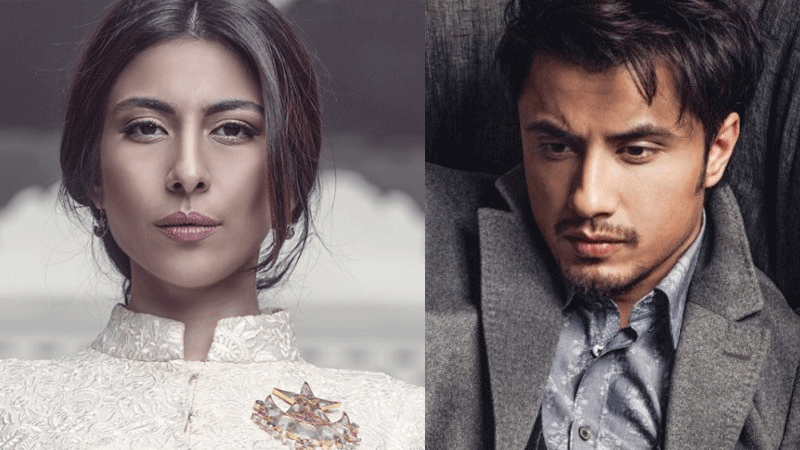
Singer Meesha Shafi has been ordered by a Lahore court to pay damages worth Rs5 million to singer Ali Zafar in a defamation suit he filed against her for damaging his reputation after accusing him of sexual harassment online in 2018.
The short order, issued by a sessions court in Lahore on Tuesday, said that the court found that Shafi’s social media post and an interview in Instep Today “contain false, defamatory and injurious imputations against the plaintiff (Zafar), whereby allegations of sexual harassment of a physical nature were levelled, which have not been proved to be true or made for public good, and thus constitute actionable defamation”.
It said that Zafar was entitled to compensatory damages on account of harm to his reputation, dignity and causing him mental anguish. However, it noted that the claim of special damages “has not been proved through cogent and reliable evidence”.
The judgement comes on the defamation suit Zafar had filed against Shafi in 2018 seeking damages worth Rs1 billion. The trial lasted for eight years, during which 283 hearings were held, a total of 20 witnesses recorded their statements, and nine judges were changed.
It is interesting to note that the verdict in the defamation suit has been given while the hearing in harassment case remains pending before the Supreme Court of Pakistan.
Shafi had originally filed the complaint against Zafar with the Punjab Ombudsperson (Protection against Harassment of Women at Workplace) but it was dismissed in July 2018 on the basis of a technicality: that Shafi and Zafar did not have an employer-employee relationship so it couldn’t be heard at the forum. The Protection Against Harassment of Women at the Workplace Act, 2010 only recognised harassment between an employee and an employer.
Shafi then approached Punjab Governor and the Lahore High Court but both dismissed the petition on the same basis. In 2019, Shafi filed the petition in Supreme Court and the case remains pending till date.
159-page detailed judgement
A 159-page detailed judgement released by the sessions judge mentions the case details in depth. It states that Shafi posted a tweet in 2018 in which she accused Zafar of sexual harassment, and she spoke in detail about the harassment in an interview with Instep Today.
On the same day as Shafi’s tweet, Zafar categorically denied any and all claims of harassment lodged against him. “I intend to take this through the courts of law and to address this professionally and seriously rather than to lodge any allegations here.” He sought damages on account of mental torture, loss of contracts, loss of reputation, and loss of business opportunities amounting to Rs100 crores.
Shafi maintained that the suit was filed to harass and pressurise her into withdrawing her lawful complaint. She claimed that he harassed her on three occasions; first, at a social gathering at her father-in-law’s residence, then at birthday part of plaintiff’s wife where he allegedly touched her inappropriately and pulled her closer without consent; and third in December 2017 during a rehearsal sessions where he allegedly leaned towards her under the pretext of reading lyrics, and on one occasion, groped her.
She maintained that it was the last incident which compelled her to cease professional engagements with the plaintiff (Zafar), althrough she initially continued limited interaction due to contractual and economic pressures.
She stated that she derived no benefit from the disclosure and instead faced threats, harassment and character assassination. She remarked that “prior cordial relations, or professional interactions do not negate harassment, as victims may continue such engagements due to coercion, power imbalance, or economic necessity.
The judge ruled that the “public dissemination of serious allegations through social media, without prior recourse to appropriate legal forums or due process, falls outside the protection contemplated under Article 4 of the Constitution. Where allegations are publicly disseminated in a manner capable of injuring reputation, the aggrieved person is legally entitled to seek redress.”
The judgement said, “the assessment and determination of compensation is ultimately the function of the Court. Even an exaggerated claim, if assumed for the sake of argument, cannot itself render the institution of a suit malicious,” adding that “in the present case, the defendant has failed to produce any independent, reliable, or convincing evidence to establish that the suit was instituted with an ulterior move or constitutes an abuse of the process of law. The plea rests on conjecture and assumption rather than proof.”
The court ruled that no provision of law has been pointed out which creates a bar to the institution of a defamation suit merely because proceedings relating to harassment have been initiated or are pending elsewhere. Thus, the mere existence of parallel proceedings does not render the present suit non-maintainable.
The court finds no substance in the plea that the present suit is a counterblast or retaliatory action. The suit is held to be competent and maintainable, and this issue is, therefore, decided against the defendant and in favour of the plaintiff.
It also ruled that “an allegation of sexual harassment is not a mere expression of dissatisfaction or criticism; it is a grave accusation suggestive of abuse of position, lack of character, and violation of bodily autonomy of a woman. In our social and cultural context, such an imputation, if made publicly against a person, particularly a well-known figure, inevitable exposes him to hatred, contempt, and loss of esteem. No further embellishment is required to categorise such words as defamatory per se.”
At this stage, the court is not required to determine whether the allegations are true or false, the judge notes. “The law is well settled that where words are defamatory per se, proof of actual loss is not strictly necessary as damage to reputation is presumed.”
‘It’s a man’s world’
Iffat Omar, a prominent celebrity and one of Meesha Shafi’s witnesses in the case, reacted to the verdict by saying “for me, Meesha Shafi’s issue ended the day every girl who supported her — including me — was dragged into criminal cases. I was told I could face three years in prison. And if that happens, I will go and serve those three years, because I do not step back from my truth — and anyone who knows me, knows this. People were silenced, pressured, bought, and scared. The entire support system was broken.”
She shared that she knows both the families and children “very closely”, adding that “if I took a side, it was 100% certainty and belief.”
“The truth is, every woman knows that at some point in her life, she has been physically harassed. Sometimes in a room full of people, someone touches you in a way you cannot even process, and you cannot even speak. We have all gone through this — as children, as young women, and even today. So when a star of this magnitude, who needed no fame, who comes from a respected family, speaks up — is it for fame? Is it some personal enmity? What did she gain from this case? What did we gain except abuse, lies, and humiliation? We did not step back because we knew that if we lost this case, then every woman who suffers this every day would lose with us. And from that day on, no woman in this country would ever be believed. The entire Lahore, the entire industry knows the truth.”
She added, “from today onwards, even I will not believe a woman in Pakistan — because surely, the man must be right. And my honorable courts, thank you for proving this. It’s a man’s world. Goodbye.”
Leena Ghani, an artist and another witness in the case, wrote in a post on social media that the harassment case against Ali Zafar is still pending. “He has not been proven innocent. He has not been cleared of anything except winning a lawsuit about a few tweets that hurt his feelings.”
She wrote, “the system protected a powerful man. It rewarded him. And just like men before him, it gave him platforms, awards, ambassadorships, PSL anthems, and now a court verdict that says his reputation is worth more than the truth of the women he harmed.”
Ghani shared that the experiences “how the system was rigged against us. The lawyers, the delays, the questions designed to make you seem angry, unhinged, unreliable. A victim not worth believing. So it does not shock me how easily the same system that dragged us through years of hearings could turn around and hand him a win.”