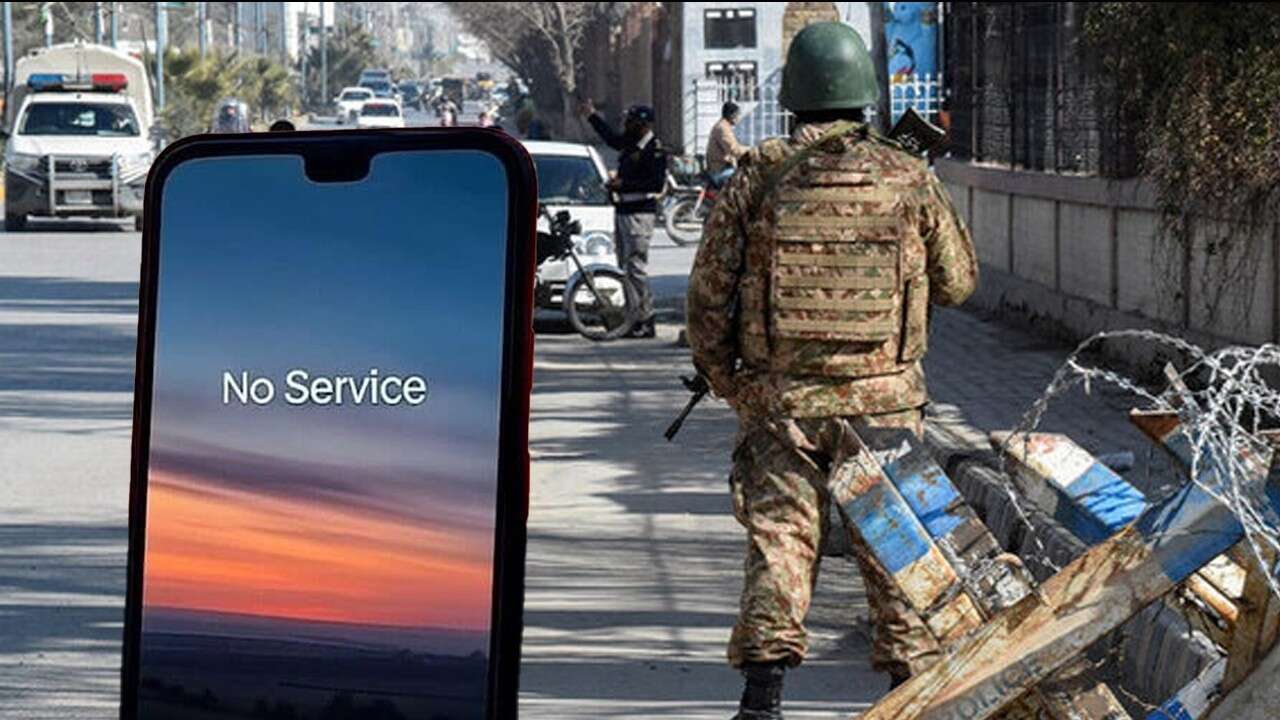
Mobile internet services have been suspended across all 36 districts of Balochistan for what authorities describe as “security reasons,” leaving millions without online access for more than three weeks. Officials say the blackout will remain in place until August 31.
The ban comes ahead of Pakistan’s Independence Day, a period when separatist attacks in the province often intensify. Authorities claim restricting internet services will prevent militants from coordinating.
Mineral-rich Balochistan is Pakistan’s largest province by area but also its poorest. It is already the country’s most underserved region in terms of connectivity, with patchy network coverage and limited infrastructure in many districts.
For decades, security forces have faced a low-intensity insurgency from Baloch separatist groups, who say the province has been deprived of its share in development projects despite its vast natural resources.
The disruption is compounded by an existing ban on inter-city and inter-provincial travel from 5 p.m. to 5 a.m., further limiting residents’ ability to move or stay connected.
Rights advocates warn that the blanket suspension violates citizens’ right to information, disrupts economic activity, and deepens Balochistan’s long-standing digital divide. For most of the province’s 15 million residents, mobile data is the only way to get online.
The impact has been immediate. University students are missing online classes. Freelancers and gig workers have lost projects. Mobile banking and e-commerce have stalled. Food delivery riders, daily wage earners, and small traders say their incomes have been wiped out overnight.
“Balochistan is already under a media blackout,” said Amir Naeem, an aspiring journalism student from Panjgur. “Social media was the only source of information for the marginalized, but now even that has been silenced.”
Naeem said his district (Panjgur) has been without mobile internet for four years, with authorities citing only “security reasons.” “PTCL landline was our only option, but now even that is gone. Private connections are too expensive. It feels like we are living in the Stone Age in the era of AI,” he said.
For some, the blackout has cut off essential contact with family. “It’s been weeks since I could talk to my family,” said Zamraan Baloch, a youth facilitator who works in Karachi. “They don’t have Wi-Fi back home, so we are completely out of touch.”
The economic fallout has been swift. Quetta-based Instagram influencer Zahoor Ahmed said he has been unable to receive payments from clients. “All Easypaisa and JazzCash vendors use mobile data. Local businesses that deliver products daily are left wondering how to keep going,” he said.
Sallam Baloch, a student and freelancer in Quetta, said the blackout has disrupted both education and livelihoods. “Students need the internet for assignments, lectures, and tools like Domino and ChatGPT. Freelancers like me depend on it to get projects, communicate with clients, and get paid. I earn 600 rupees per task, but without 4G, I lose money whenever I’m outside my home Wi-Fi,” he said. He added that small businesses running on WhatsApp channels, and even international NGOs, have been affected. “If someone has a relative with Wi-Fi, they can manage. But students far from home are living in uncertainty. Only we know how hard it is to keep things going.”
Namud Hijab Changezi, a youth and peace activist from the Hazara community in Quetta, said the blackout has disrupted her research work, online campaigns, and fellowship programs. “Tasks that should take a day or two now take more than a week. Deadlines are approaching, and I may have to pay to go to an internet café just to apply for MPhil admissions,” she said.
While Changezi acknowledged security concerns, she stressed that the complete shutdown is too damaging. “Cellular networks are working, but without internet, much of our work just stops,” she said.
Business leaders in Quetta have called for targeted measures instead of province-wide restrictions. Lawmakers in the Senate have also filed a motion challenging the suspension, calling it disproportionate and harmful.
Critics warn that prolonged restrictions, such as the ongoing internet shutdown, could further isolate communities and silence voices from a region rarely represented in mainstream media.
Digital rights experts warn that repeated shutdowns in Balochistan set a dangerous precedent for curbing civic freedoms. Of the province’s 15 million residents, 8.5 million rely on mobile internet, and for now, they remain offline, cut off from education, work, and the outside world in a province where staying connected is already a struggle.